Investing in a diode laser removal machine is one of the most important decisions for any clinic, salon, or distributor in the aesthetic industry. Hair removal remains the foundation service of most aesthetic businesses, and the quality of your laser equipment directly determines treatment outcomes, client retention, and long-term profitability.
However, not all diode laser machines are built to the same standard. The wrong choice leads to inconsistent results, expensive repairs, and disappointed clients. The right choice becomes a reliable workhorse that generates revenue for years.
This guide is written specifically for B2B buyers — clinic owners, salon chains, distributors, and brand partners — who need to make a confident, informed purchasing decision.
Diode lasers operate at a wavelength of 808nm (or near-infrared), which is considered the gold standard for laser hair removal. This wavelength targets melanin in the hair follicle with high precision while minimizing damage to surrounding skin tissue.
Compared to IPL (Intense Pulsed Light), diode lasers deliver:
More concentrated energy — true laser beams penetrate deeper into the follicle
Faster treatment times — larger spot sizes and higher repetition rates
Better results on darker skin types — advanced cooling and pulse control reduce risk
More treatment sessions per day — consistent performance without overheating
For a deeper comparison, read our article on the difference between IPL and diode laser hair removal and our guide on IPL vs. laser hair removal: pros, cons, and which one to choose.
B2B Tip: If your business model depends on high-volume hair removal, a true diode laser system will outperform IPL in both efficiency and client satisfaction.
Power output is one of the first technical specifications to evaluate. Measured in watts (W), the power level determines how fast and effectively the laser can treat large areas.
1200W systems — suitable for small to medium clinics with moderate daily volume
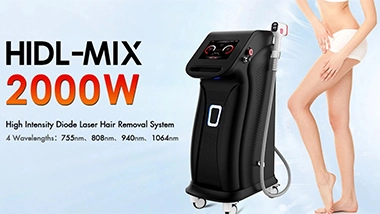
1800W–2000W systems — professional-grade machines for busy clinics treating multiple clients per day
3000W systems — high-power machines designed for high-volume clinics, medical spas, and chains
Higher wattage means faster treatment times, better energy delivery to deep follicles, and the ability to maintain consistent output across long working days. For example, a 2000W 808nm diode laser machine can treat a full back or both legs significantly faster than lower-power alternatives, allowing you to serve more clients per day.
If your clinic operates at high volume, explore our 3000W 808nm diode laser hair removal machine, which features exchangeable spot sizes for flexible treatment protocols.
B2B Tip: Do not evaluate price without comparing wattage. A lower-priced, lower-watt machine may cost more in lost productivity over time.
Modern diode laser machines come in single-wavelength and multi-wavelength configurations. The choice affects which skin and hair types you can treat safely and effectively.
808nm only — the industry-standard wavelength, excellent for most skin types (Fitzpatrick I–V)
755nm + 808nm + 1064nm — triple-wavelength systems that cover lighter skin, medium skin, and darker skin
755nm + 808nm + 940nm + 1064nm — four-wavelength systems offering the broadest treatment range, including fine blonde hair and deep dark skin
Multi-wavelength machines allow your clinic to serve a more diverse client base. For example, the 755nm wavelength targets fine, light hair effectively, while the 1064nm wavelength is safer for darker skin tones. Learn more in our article about the role of different wavelengths in diode laser removal machine handles.
If you want maximum versatility, consider our 4-wavelength diode hair removal laser machine or 755nm/808nm/940nm/1064nm laser diodo hair removal machine.
B2B Tip: If your client base is diverse in skin tone and hair color, a multi-wavelength machine is a strategic investment that expands your addressable market.
Spot size determines how much skin area is treated with each laser pulse. Larger spot sizes mean faster treatments, which directly impacts your daily revenue capacity.
Standard spot sizes range from 12mm × 12mm to 15mm × 25mm
Some advanced systems offer changeable or adjustable spot sizes, allowing you to switch between large areas (back, legs) and precision areas (face, bikini line)
Handle design also matters for therapist comfort during long treatment days. Ergonomic, lightweight handles reduce fatigue and allow consistent technique. Our changeable spot size diode laser hair removal machine gives clinics flexibility without needing multiple handpieces.
For high-volume environments, double-handle 808nm diode laser systems allow two therapists to work simultaneously from one machine, or one therapist to switch between handles for different treatment areas without downtime.
B2B Tip: Ask suppliers for the exact spot size dimensions and whether handles can be swapped or upgraded without replacing the entire system.
Effective skin cooling is not a luxury feature — it is essential for safe, comfortable, and effective diode laser hair removal.
Without proper cooling, the laser energy that targets the hair follicle also heats the skin surface, causing discomfort, redness, and in worst cases, burns or pigmentation changes. A professional diode laser machine should include:
Contact cooling — a cooled sapphire or quartz window on the handpiece that chills the skin before, during, and after each pulse
Air cooling — external cooling systems that blow chilled air onto the treatment area
Water circulation cooling — internal cooling that prevents the laser components from overheating during continuous use
For clinics that want to maximize client comfort, adding an external air skin cooler machine creates a significantly more comfortable experience, especially for sensitive areas or clients with low pain tolerance. Read more about the role of skin cooling systems in modern aesthetic treatments.
B2B Tip: Test the cooling system before purchase. A machine that cannot maintain stable cooling after 4–6 hours of continuous operation will limit your daily capacity.
For B2B buyers, certifications are non-negotiable. They protect your business from legal liability, customs rejection, and market-access barriers.
Before committing to any supplier, verify that they can provide:
CE Medical certification — required for European and many international markets
FDA clearance — essential for operating in the United States
ISO 13485 certification — demonstrates a quality management system specific to medical devices
Professional manufacturers are transparent about certifications and provide documentation without hesitation. If a supplier avoids sharing certificates or provides only unclear photocopies, consider it a serious warning sign.
B2B Tip: Ask for the certificate number and verify it independently with the issuing body. Fake or expired certificates are more common than buyers expect.
The aesthetic equipment market includes real manufacturers, trading companies, and short-term operators. Knowing the difference protects your investment.
A real manufacturer should demonstrate:
Owned factory with visible production and R&D facilities
In-house quality control and pre-shipment testing for every unit
Engineering team capable of technical support and troubleshooting
Long-term presence in the market with verifiable client references
Trading companies may offer lower prices, but they rarely provide reliable after-sales service, spare parts availability, or consistent product quality. For guidance on vetting suppliers, see our article on how to choose a reliable diode laser hair removal machine supplier.
B2B Tip: Visit the factory if possible, or request a live video call showing production and testing areas. Serious manufacturers welcome transparency.
The machine purchase is only the beginning of the relationship. For clinics and distributors, after-sales support determines the total cost of ownership.
Evaluate the supplier on:
Warranty terms — two years is the professional standard for diode laser systems
Technical support response time — can they respond within 24–48 hours for critical issues?
Training resources — do they provide operation manuals, treatment protocols, and staff training?
Spare parts availability — can you source replacement handles, power supplies, and cooling components long-term?
Software updates — is the operating system upgradable?
A supplier who views the sale as the start of a partnership, not the end of a transaction, is the right long-term choice.
If you plan to distribute under your own brand, customization capability is a key evaluation point.
Professional manufacturers with OEM/ODM experience can support:
Custom machine housing colors and finishes
Logo placement on hardware and software interface
Multi-language operating systems
Custom packaging and documentation
Exclusive spot size or power configurations
A supplier with strong OEM/ODM services helps you build brand differentiation and command better pricing in your local market.
The physical form factor of your diode laser machine should match your business environment.
Portable diode laser machines — compact, mobile, ideal for small salons, mobile services, or multi-room clinics where the machine needs to move
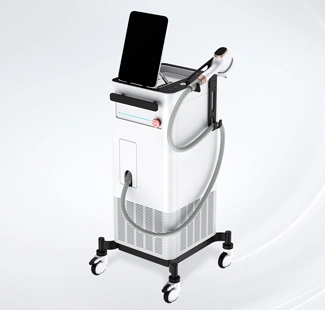
Vertical diode laser machines — larger display screens, stronger internal cooling, more powerful outputs, better for high-volume fixed-location clinics
Explore our portable diode laser machines for flexible deployment, or our vertical 808nm diode laser machines for maximum performance in dedicated treatment rooms.
B2B Tip: Do not compromise on power or cooling just to get a smaller footprint. Choose the form factor that fits your space without sacrificing treatment quality.
Choosing the right diode laser removal machine impacts every part of your aesthetic business:
Client satisfaction — visible, lasting results bring repeat bookings and referrals
Treatment efficiency — faster sessions mean more clients per day and higher revenue per room
Operational reliability — a well-built machine minimizes downtime and repair costs
Staff confidence — intuitive interfaces and consistent performance reduce training burden
Business reputation — reliable equipment supports a professional brand image
For a deeper understanding of diode laser technology and its applications, explore our articles on what is diode 808nm laser hair removal treatment and semiconductor laser hair removal machine technology, configurations, and professional applications.
If you are:
A clinic or salon chain expanding your hair removal services
A distributor or wholesaler seeking high-quality aesthetic equipment
A brand owner looking for OEM/ODM diode laser solutions
SANHE LASER can support your business. With 18+ years of manufacturing experience, two production facilities, and global certifications including CE Medical, FDA, and ISO 13485, we supply diode laser hair removal machines to partners in over 100 countries.
Our diode laser product range includes:
Contact us today to discuss:
Product specifications and power configurations
Certifications and regulatory support for your market
OEM/ODM branding and customization
Pricing, warranty, and long-term partnership terms
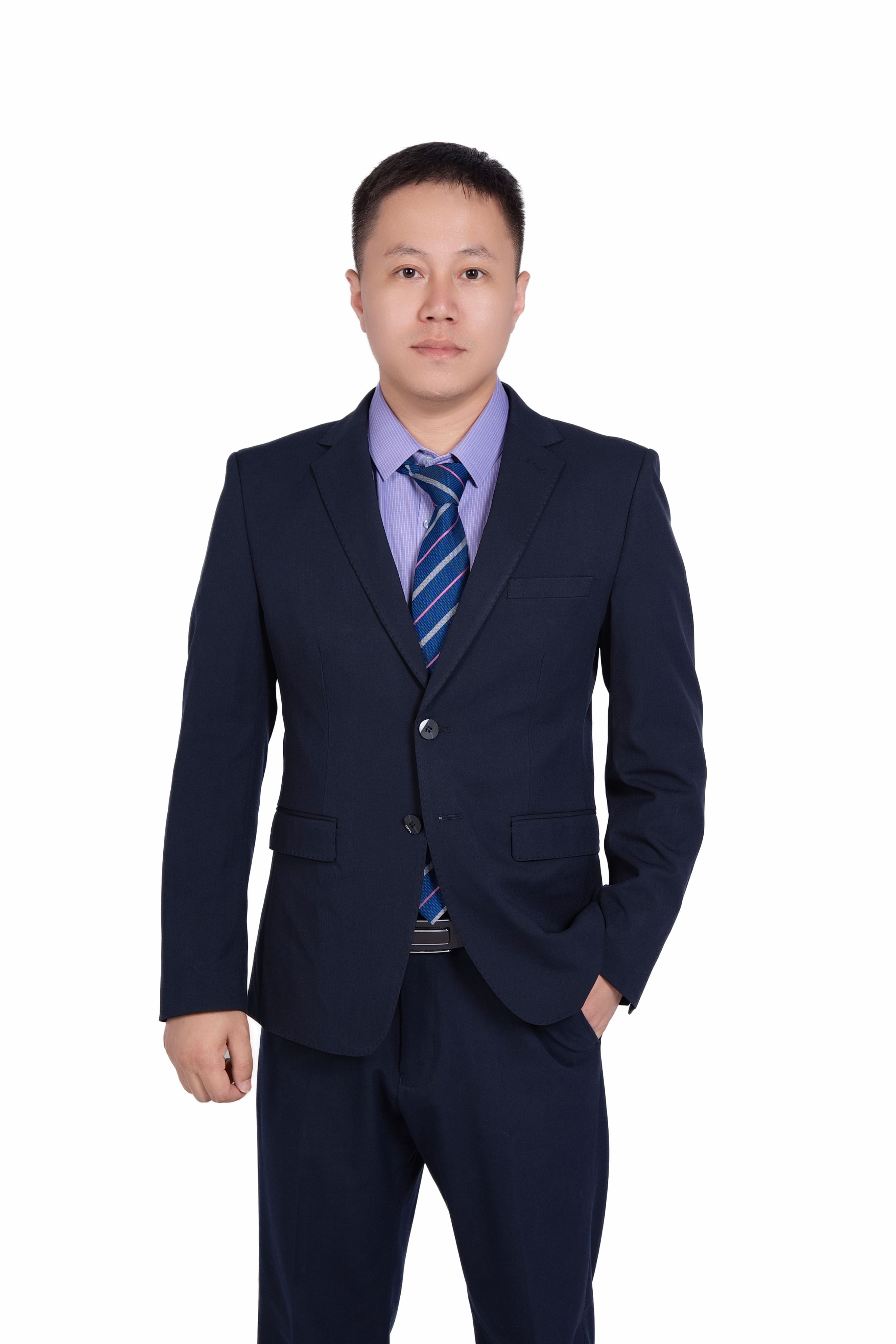
Sales Director: Mark Ren
The Bei Jing San He Tech Co., Ltd is dedicated to driving continuous growth and innovation in the beauty machine industry. With over 12 years of experience in sales and marketing, I am well-versed in market trends and customer needs. I firmly believe that high-quality products and exceptional service are key to winning the market. I always focus on product quality and customer experience, ensuring that every customer enjoys the most advanced and effective beauty solutions.

 English
 日本語
日本語 français
 Deutsch
 Español
 italiano
 русский
 português
 العربية
 Ελλάδα
 فارسی
فارسی